Thursday, May 5, 2022

An African Safari - Day 6 – 15 March 2022 - A day trip to Victoria Falls

I had secured online visas for Zimbabwe and Zambia before travelling to Botswana with the intention of driving in these countries. Those plans fell flat with all car hire companies in Botswana prohibiting their cars to be taken outside Botswana, except to South Africa. Therefore, I arranged for a day trip to Victoria Falls. The border posts open at 6 am and I was at the Botswana post by 6.15 am. I was alone at the Immigration and completed formalities in 5 minutes.

The transporter from Zimbabwe met me at the Botswana Immigration and took me over to the Zimbabwe side. I was asked to wait a while as their systems were being rebooted. I noticed a circular posted on one of their windows of fees for different purposes. What struck me as odd was the different visa fees for different nationals. It was the highest for Canadian passport holders at $70, then the Chinese at $60 and British at $55. There was no mention of other nationalities.

A few 3-seater steel chairs were placed near the Immigration windows for people to await their turn. One of them was turned upside down and a monkey was keenly inspecting it. While I was videographing the scene, about 15 minutes from the time I reported to the counter, they located my visa online and stamped the passport. They also gave me a fee receipt for $45 for the multiple entry visa I had applied for online. I was permitted entry into my 50th country.

As I was moving from the counter, inspecting the stamp in the passport, I tripped on the steel bench and fell, injuring the right side of my face. One of the cuts bled profusely. The ground I fell to was dirty and dusty. Fortunately, I had Dettol wet wipes that I had kept in my backpack at the last minute in a hunch. I used them to clean the wound and bruises. The bleeding refused to stop and, for a while, I thought that my trip would have to be aborted. I packed the right ear with the wet wipes and kept them for some time. That seemed to reduce the blood flow. I kept applying pressure at the spot and the blood seemed to clot.

The distance to Victoria Falls from the Zimbabwe border is 73 km, which was done in an hour, with due disregard of the 80 kph speed limit. The transporter, Max, knew exactly where the police could be. I doubted if they had many patrols at that time because of wild animals. The road cuts through the Zambezi National Park and I noticed an elephant and a hyena during the drive. There are signages at intermittent locations warning drivers not to stop their vehicles. Max told me of a recent incident where a parked car had been smashed by an elephant.

As we nearest Victoria Falls I requested Max to take me to a pharmacy to buy some dressing. The young girl packed me a bottle of betadine and a bandage, after seeing the cuts, and told me that I should get to a clinic in the neighbourhood. Max took me to the Bridge Health Clinic. A look at the cuts and the nurse on duty told me that I would have to pay $80 to see the doctor and separately for the dressing. Another person, who seems to be head nurse, brought it down to $50 when I told her that I have the bandage and betadine. When I insisted that I would not want to see a doctor and needed only the dressing she brought that down to $20! Linda and Lazy cleaned up the bruises and cuts in the Resuscitation Room and tied the bandage in such a way that it would continue to apply pressure on the wound to stop bleeding. The only problem was that the bandage covered a portion of the right eye too, obstructing vision and sleeping the bifocals We struck up a conversation and Linda told me that she watches a lot of Bollywood films. Her favourite stars are Salman Khan and Kareena Kapoor.

Hiring a poncho for $4, USD is legal tender in Zimbabwe, I paid the entrance fee of $30 and stepped into fantasy land. The Victoria Falls, Mosi-oa-Tunya (The Smoke That Thunders) to the locals, was discovered by David Livingstone, a Scottish physician, entrepreneur and explorer. Livingstone, on seeing the massive waterfall named it after the British Monarch at the time, Queen Victoria. Later he recorded in his journal these famous words:

'No one can imagine the beauty of the view from anything witnessed in England. It had never been seen before by European eyes; but scenes so lovely must have been gazed upon by angels in their flight".

The magnificent curtain of frenzied water, on the border between Zambia and Zimbabwe, is on the Zambezi River and is more than 1700 metres wide. The towns of Victoria Falls, Zimbabwe and Livingstone, Zambia stand on either side of the mile wide waterfall and the mighty Zambezi River.

The nearly 3 hour round trip walk has 16 identified stations, starting with a life-size statue of the intrepid explorer. Despite the poncho I was fully drenched in less than half hour from the spray and rain. The Falls is impressive and massive, particularly the Horseshoe. On completing the walk I pared into the Rainbow Cafe for a wholesome meal of grilled Zambezi Bream fish with veggies and chips.

One can obtain a Bridge Pass to walk from Zimbabwe to Zambia across the Victoria Falls Bridge. Road, rail and pedestrian traffic between the two countries take place across this bridge built in 1905 at the initiative of Sir Cecil Rhodes. The bridge has three segments, Zimbabwean and Zambian sections and a no-man's land in between. The bridge is also used for bungee jumping and zip lines. I could not do either because of the injury.

At the entrance to the bridge was a 'boneless wonder'. The many contortions he did with his body elicited laughter and awe from those around him. It seemed that the man had neither bone nor muscle. He walked with me for some distance and asked for some money. He looked happy with BWP 20 I gave him. I met Paul around halfway on the bridge. The Zambian explained how at this of the year there is more water on Zimbabwean side of the Falls. He walked me to the Zambian end of the bridge and took me to a couple of lookout points to take a few photos. Once that was done he too asked me for a few Pulas.

One of the things that mesmerised me is the wood work; the carvings are exquisite. Works in jade, lapis lazuli and malachite also stand out. The Falls has very few visitors and vendors bemoaned the bad times they are in. I had a long chat with Arthur, Peter and Paul about their economic conditions. Things didn't look too good. Bargains can be had of the crafts if one chooses carefully. I do not know if I did.

The drive back to the border was uneventful and I took short naps till I got back to the border posts. The passport was stamped by Zimbabwe and Botswana Immigration and I was picked up by a taxi to get back to the hotel. Once I settled in Abin, who had come to Kasane in a business trip, took me to the New Hope Clinic for a tetanus shot and another round of dressing. The doctor explained that the cuts are superficial and would not require any other attention than regular cleaning and dressing. Thank God for that. I did not even ask for painkiller as I did not have any pain at all, which surprised the doctor too. What surprised me was the "I am sorry" I heard from anyone who asked about the accident or saw that I was hurt. Even the nurses kept saying, "I am sorry", while they were cleaning and dressing the cuts. Hearing it being said all the time made me feel sorry for having tripped and fallen.

Wednesday, May 4, 2022

An African Safari - Day 5 – 14 March 2022 - In Kasane

The significant part of the day's schedule was the Game Drive in the Chobe National Park (CNP). The arrangement was that I would be picked up at 5.30 am. I got ready in time when a Land Rover, modified to carry up to 12 passengers, reached the Logan Safari lodge. The driver of the vehicle would double up as the guide too. He told me that we had a few others to pick up too on the way. We stopped at two other lodges and picked up two families of five other co-passengers, all residents of Botswana. One family was particularly chirpy and kept the others in splits too.

The day was breaking and the rising sun was gradually dressing up the horizon and the sky in ever changing hues. We reached the Park and the guide went in to sign up for the guests. I learnt from an inscribed slab at the entrance of the CNP that it started as a Game Reserve in July 1960 and was converted as the first national park in August 1967. The San were the original inhabitants of the region. A feature of the CNP is reportedly the large population of elephants.

It is here that I read about KAZA TFCA, an amazing initiative of five neighbours, namely Angola, Zambia, Zimbabwe, Botswana and Namibia, with a clear focus on transfrontier conservation and appropriate land use as well as reaping the benefits of the bi-product of tourism in the Okavango and Zambezi River basins. The area involved a land mass bigger than Germany and Austria combined or nearly twice the size of UK! The jewels in the spectacular protected area are the largest inland delta system in the world – the 15,000 sqm Okavango Delta – and one of the seven natural wonders of the world – the 1700 meter wide Victoria Falls. CNP, which is part of this ecosystem, is Botswana’s second largest park with habitats that include riverfront thickets along the Chobe River, rich grasslands, floodplains and forests of acacia, baobab and mopane trees. The Savuti Marsh, made famous by numerous wildlife documentaries, is a popular destination for tourists and the scene of dense wildlife concentrations and large zebra and wildebeest migrations.

Once the signing in was completed the driver cum guide poured water on all the high hopes we had. He said that since the park was lush with tall vegetation and there was plentiful water everywhere, the chances of seeing elephants and lions were slim. That was that. He turned out to be spot on. After a while, even seeing winged friends and a tiny squirrel were enough to get the mouths agape and sequel in delight.

Impalas were everywhere and they seems to have got used to visitors. They stood gazing and so did some baboons and a buffalo. The baboon bunch was large with babies still clinging in to their mothers. We did get to see one elephant carefully shepherding the young from one side of the road to another. That scene brought home the fact of a mother's role in society and a child's life. In the three hour tour of the park we spotted some hippos, pukus and kudus too. Just before concluding the game drive all the guests, in various safari jeeps, met under a few trees for coffee and biscuits. 

To visit the Victoria Falls in Zimbabwe I have to produce a recent RTPCR test result, I was told. After returning from the game drive and breakfast I drove to the Diagnofirm clinic for the test. The young doctor at the DML, who had graduated from the University of Botswana, Gaborone, told me that the charge would be 750 BWP, almost INR 5000. When I asked him for a senior citizen discount he told me that he would give me a good one the next time around! The doctor told me that I could come by around 4 pm for the result. They also have an express service whereby the result could be obtained in one hour for double the rate.

I was keen to visit the border posts of Zimbabwe and Zambia as they were just a few km away from where I was staying. I checked with the Botswana Customs if I could keep my car at the border post the next day, take a day trip to Zimbabwe and retrieve my car in the evening. The officer was so iffy that I decided against it. At the Zambia border I wanted to go on the Kazungula Bridge to see the unique phenomenon of the quadri-point of Botswana, Namibia, Zimbabwe and Zambia. A young police officer told me that I would have to go to Customs and get a Bridge Pass. I decided against that and returned to the lodge. Later in the evening I went to the clinic and collected the RTPCR test result that certified me fit to cross the border the next day.

An African Safari - Day 4 – 13 March 2022 - Francistown to Kasane - 516 km

It was to be the longest drive till date in the 15th edition of Record Drive. I had rested well in the lovely home of Aswathy and Abin. That is a prerequisite for a smooth and interrupted drive. Moreover, the mind had been soothed by the filial company of the lovely couple and Aryan. I was meeting them for the first time and they made me feel as if I have known them since long. Some people have the innate ability to make others feel at home. Abin and Aswathy belong to that group. 

Aswathy is a remarkable cook and baker. However, on a matter of principle she has not commercialized her talents. The day began with wishing Abin a very happy birthday. Aswathy had baked a cake for the occasion, a construction site being the theme, celebrating Abin personal and professional life. This wonderful couple and their son, Aryan, have made me a part of the family. Such relationships are the real gain from any travel, I acknowledge.

Abin had suitably warned me of the condition of the roads till Kasane, short stretches that were really bad and had to be carefully negotiated. Moreover, the route passed through game parks and a sharp lookout had to be maintained for animals crossing or frolicking across the road. By and large the 500 plus km was comfortable, with huge potholes in many locations. I used to keep a freight truck ahead of me in bad stretches to be prepared of the potholes. A couple of elephants and warthogs were all that I saw en-route. Nearing Pandamatenga it was heartening to see large swathes of land under cultivation. Local production of fruits and vegetables is being actively encouraged by the government by stopping imports from neighboring countries. This policy immediately reflected on the availability of fruits and vegetables in the market. Potatoes and cabbages became rare and costly.

Just short of Pandamatenga I was waved down by a traffic patrol. Two speed boards, one 60 and the other 80, were placed at a distance of less than 100 metres. I had reduced speed to 60 while passing the speed board. When I sighted the 80 I increased speed about 20 feet short of the board that permitted 80. Despite making a fervent appeal for amnesty the young officer politely took out his challan register and wrote out a fine of BWP 460. He had a printed and laminated ready-reckoner to calculate the fine. Despite the delay for paying the fine I covered the distance to Kasane in a few minutes and 6 hours.

Abin had made arrangements for my stay and activities with Logan Safaris, who owner, Elias, Abin knew personally. I was booked into their Lodge near Kazungula, which has eight rooms, a kitchen and a dining. The small pool would be a good place to cool off in the seating summer heat. Elias happened to be in Gaborone on work. His able assistant, a multi-tasker who manned the reception, got the rooms ready, swept and mopped the entire lodge, told me that Elias had made arrangements for a game drive in the afternoon. I had hoped to do the boat cruise and view the sunset from the Chobe River. Elias spoke to me and said that due to a paucity of tourists he was unable to find someone to take me on the boat cruise. Instead he said he had arranged a game drive, gratis. I agreed because of the change in my schedule.

I was supposed to have gone to Zimbabwe tomorrow to view the Victoria Falls and stay there overnight, enjoying a traditional Boma dinner with traditional artists performing the drums and other instruments. On my way to Kasane, Elias informed that I required an RTPCR test result for entry into Zimbabwe, which meant that I had limit the Victoria Falls trip to just a day venture. This day being a Sunday, I would have to do the test tomorrow morning.

As I was mentally prepared for the Game Drive, the receptionist, Michelle, informed that they were able to find someone to do the boat cruise and that I would have to report at the Spar market in Kasane as soon as I could. I gathered my backpack and drive to the appointed rendezvous location, where I was met by the tall Cherish. He took me to a private jetty just behind the market complex. The small boat already had three guests seated in it. Later, we were joined by another couple.

The Chobe National Park, established in 1967, is the second largest wilderness park in Botswana encompassing over 11,700 sq km. The National Park is mainly known for its large herds of Elephants and Cape Buffaloes. The Chobe River is the northern boundary of the Chobe National Park and it also marks the boundary between Botswana and Namibia near Kasane. The waters are shared, but you can step on to the respective lands only with valid visa. The Chobe River cruise is one of the recommended activities in Kasane.

Besides spotting many birds and being explained its speciality by an exceptionally gifted guide of Cherry Safari, the group of six in a small boat had close sightings of elephants, hippos, crocs, buffaloes and warthogs. Many luxury lodges and hotels dot the riverine coast on both sides. Specially fitted out crafts take enthusiastic wildlife photographers to indulge in their passion. The guides on the boats communicate efficiently to share information on possible sightings.

The Sedudu Island in the Chobe River was a disputed real estate between Botswana and Namibia. In early 1990s, the International Court of Justice settled the dispute in favour of Botswana. Since then Botswana has ensured that its flag fly in the island at all times, asserting its possession. The three hour boat ride lasted till sunset.

An African Safari - Day 3 – 12 March 2022 - Goo Moremi Gorge to Francistown- 206 km

It must have been the mind playing tricks. I could have sworn that there were animals near my tent during the night. In the night the noises get amplified and, at times, are scary. I prayed not to get the urge to use the ablution enclosure during the night.  After a while I slept without a care in the world. It was past five when I woke up in the morning when a curious group of langurs came visiting. They were up in the trees surrounding the camp site, peeping, jumping and ducking. They were so human in their mannerisms. It seemed to be a large family because there were mature and very small ones among them.

A hot cup of coffee in the morning is a force of habit. Without a kettle I was lost. After 6 am I drove to the reception and was told by the security guard that the kettle would be sent to my tent as soon as the reception opens. In a while I got the hot water done and realised that I had not brought a spoon with me. I broke a twig from one of the trees and cleaned it thoroughly before using it to stir the coffee. All this while the langurs were keenly watching me. They were alright as long as I was sitting down and relishing the coffee I had made. I could make out that they were shortening the distance gradually. They must have been curious because they saw someone with a similar crop of white hair and a dark face, but without a tail! When I got up to take a close up shot of the nearest one they all vamoosed.

Once breakfast was done Mr. Pilot, the GM of Goo Moremi Gorge Resort paid a visit to my tent and detailed the government-community initiative the resort project is. I asked him why he was carrying a longish stick because he didn't seem old or unfit to be using a support. He casually mentioned that it was to guide the Mamba and Spitting Cobra snakes to go their way and not disturb him! That sent chills down my spine. The ten year partnership between the community and the government had paid off with handsome dividends to the community due to increase in tourism. The partnership, however, was soon to end. The community would soon be taking complete control of the Goo Moremi Gorge Resort and its activities. Pilot told me the various expos and road shows he participated in to improve the business of the Resort. I told him that he must impress upon the Botswana Government to have effective road shows in India, where people were looking for new avenues of fun and adventure.

I ate up another sandwich of multigrain bread and smoked ham over a cup of coffee before embarking on the trip to Francistown. Duly returning the battery operated led light to the reception I reached the gate to be given a huge smile by Mike, the security guard. He opened the gate and gave me an effusive send off. As I nearest the village I was shocked to see hundreds of cars parked on either side of the sandy road. I wondered what the reason for such a large gathering would be. I thought it was some kind of weekend get-together, as loud music could be heard from inside the bushes. When I got to a clearing the reason became crystal clear. There had been a death in one of the families and the Modiba funeral arrangers were at their job.

The drive to Francistown was smooth on A1 after I had backtracked over 50 km from the resort on the road I had travelled yesterday. Abin Antony Pattamana, a young entrepreneur with his own construction company, and his talented wife Aswathy and their affectionate son, Aryan hosted me in Francistown. Abin took me to the Our Lady of the Desert Cathedral, for worship and prayer. A visit to the Supa Ngwao Museum proved futile as it is closed during the weekend. The museum is believed to showcase local heritage. Francistown is the second largest city in Botswana with a population of over 100,000. The city has two main streets and all the life happens in and around them. Abin patiently pointed out important buildings and institutions. One of the things he mentioned was an eye opener. Most of the established businesses and initiatives have Indian roots like, Choppies, Motovac, GUC, Trans, etc.

I was spoilt silly by the food that was put on the table at lunch and dinner - too much in the belly - which had to be burnt a bit. Towards that Aryan and I turned our hands and swung the bat in a friendly cricket encounter. Interacting and staying with Abin and his family added further insights into the Botswana way of life. While the Batswana are generally very friendly, a spate of crime involving locals has shaken the collective conscience. There have been a couple of cases of break-in even in Abin's superb estate.

An African Safari - Day 2 – 11 March 2022 - Serowe to Goo Moremi Gorge - 115 km

The stay in Rest and Digest guesthouse had been pleasant and restful. While showing me to the room Sego had told me that it would get cold in the night and showed me where the blankets were kept. I did not believe her as it had been sweltering hot then. Into the night I woke up to switch off the air conditioning and it was cold. I woke up early and completed the left over documentation over hots cups of coffee. There was still a slight nip in the healthy air when I went out for a small jig in the compound of the guesthouse. I had two large sandwiches of multigrain bread and smoked ham for breakfast with yet another cup of hot coffee.

By 9.30 am I was ready to embark on the second day of the African Safari. I met Margaret, the owner of the guesthouse, paid the dining charge and gave her feedback of the stay at her house that had eight rooms on rent. Last night she had promptly attended to a glitch in the wifi connection. This morning I told her that she had to fix the shower cubicle and curtain. She was aware of the matter and said that she had decided to replace the present one. She told me that she wished to travel to India and I gave her my contact details if she wanted someone to be her host.

I had to backtrack 40 km to Palapye via Morupule to get back to the A1. I travelled about 35 km on the route to Francistown before branching off to the right for Moremi, which was another 40 km after the turn off. I had been told that Google Maps would lead me to the Moremi Village and not to the Goo Moremi Gorge Resort. I found a couple of ladies waiting at a bus stop and asked one of them for directions to the Resort. She told me to turn off after the local school and "drive on till you arrive". The Goo Moremi Gorge Resort was about 5 kms from the village along sandy roads. At some places I wondered if my small car would get stuck in the sand. Mercifully it did not and I arrived at the gate of the Resort where I was registered and asked yet again if I wanted only the basic camping tent. The lady at the reception told me that I would find the beds "tiny". I was not going to pay top dollar for a bigger bed and confirmed the camping tent for the night stay The basic tent accommodation cost BWP 580 along with another 55 for vehicle entry and another 10 as tourism tax. A Nature Walk was part of the package rate.

The receptionist told me to go through a 3 km trail of sandy road to do the Nature Walk before going to the camping tent. Along the road I wondered what I would do if I came across another vehicle in the opposite direction. I would not be able to go off the main track as I would get stuck in the sands. Exactly that happened in a short while. Fortunately, the car reversed a fair distance and let me pass knowing my predicament. At the end of the 3 km drive is a large parking area where I was met by Zuma, my guide. The next 90 minutes was fascinating. The legend of the Gorge, the many plants and trees in them, the origin and end of the water source, the three waterfalls and the vultures breeding there were all part of the most informative walk with Zuma. Before the walk began Zuma told me that venomous snakes are a part of the landscape and that I must tread cautiously. The Mamba and Spitting Snake are the most common ones here.

It was hot and sweaty. The walk has to be taken carefully because of small streams, tree nettles, slippery rocks and steep climb. The Moremi Gorge is considered to be one of the most spectacular gorges in Botswana. The Gorge is part of the Tswapong Hills and is a geological phenomenon of weathering over 1700 million years. The Bapedi tribe who lived in the area found the spring a source of water for themselves and their animals. The Bapedi believed that the spirits of their ancestors live in the Gorge and hence, swimming in the pools formed by the streams is prohibited. Even to this day the villagers seek mediation with their ancestors through a process called Komana. It is a protected site and therefore, nothing can be removed from the Gorge, including stones and plants.

Zuma turned out to be a very informative guide. He showed me wild figs that grow stubbornly even through rocks. The figs turn brown when they are ready to be eaten. Wild fern and a type of grass grow only beside clean water; their presence indicates that the stream contains clean potable water. The grass is used by villagers to weave baskets used for storage. Zuma showed me the white core of the grass that apparently keeps the water clean. The camphor plant leaves, when crushed gives off a powerful smell. Tribes’ people who lived in the Gorge smeared the paste on their bodies to mask their smell from predatory animals. On the other hand, the powdered lavender croton leaf was the source of ancient deodorant! Zebra and other wild animals ward off ticks by eating aloe vera. The aloe makes the blood bitter and poisons the tics which eventually fall off the animals. Nature has it all. Warnings have been put on tree nettles not to touch them. Zuma pointed out baboon poop, which was easily identifiable, for it contained leftovers of berries they mostly live on here.

The Nature's Walk culminates at the Third Waterfall. The waterfalls are not full of water. They are minor falls. But the setting is spectacular. The origin of the water is from atop the Gorge. It springs from the rocks and keeps flowing down perennially. The flowing stream does not end up in a river or pond. It disappears into the ground at some point. All in all, the Nature's Walk and the Gorge experience was worth the time spent.

A couple of fully grown kudus, the second biggest in the antelope grouping, almost ambushed me on the way back to the tent. They hopped, stepped and jumped across the road and startled the daylights out of me. I was bushwhacked by the time I got to the tent. Hungry and tired. I attended to hunger first. Sandwich and water. I was all sweat and dirt. The ablution enclosure, slightly away from the tent, has a wash basin, a toilet and an open shower area. The camping tent I was allotted stood in a cluster of three. The other two seemed to be accommodation for families. I discerned that the dry heat would be ideal to dry clothes. I had accidentally stepped into a stream and the pant and shoes had got dirty during the Nature Walk. I had a few other clothes to wash too. I was the only resident in the tent complex. I washed all the clothes and had a bath in the buff. It is when the water started running down the body that I realised that vultures feast on dead meat. Once the owner's pride and neighbour's envy, it is now the vulture's feast!

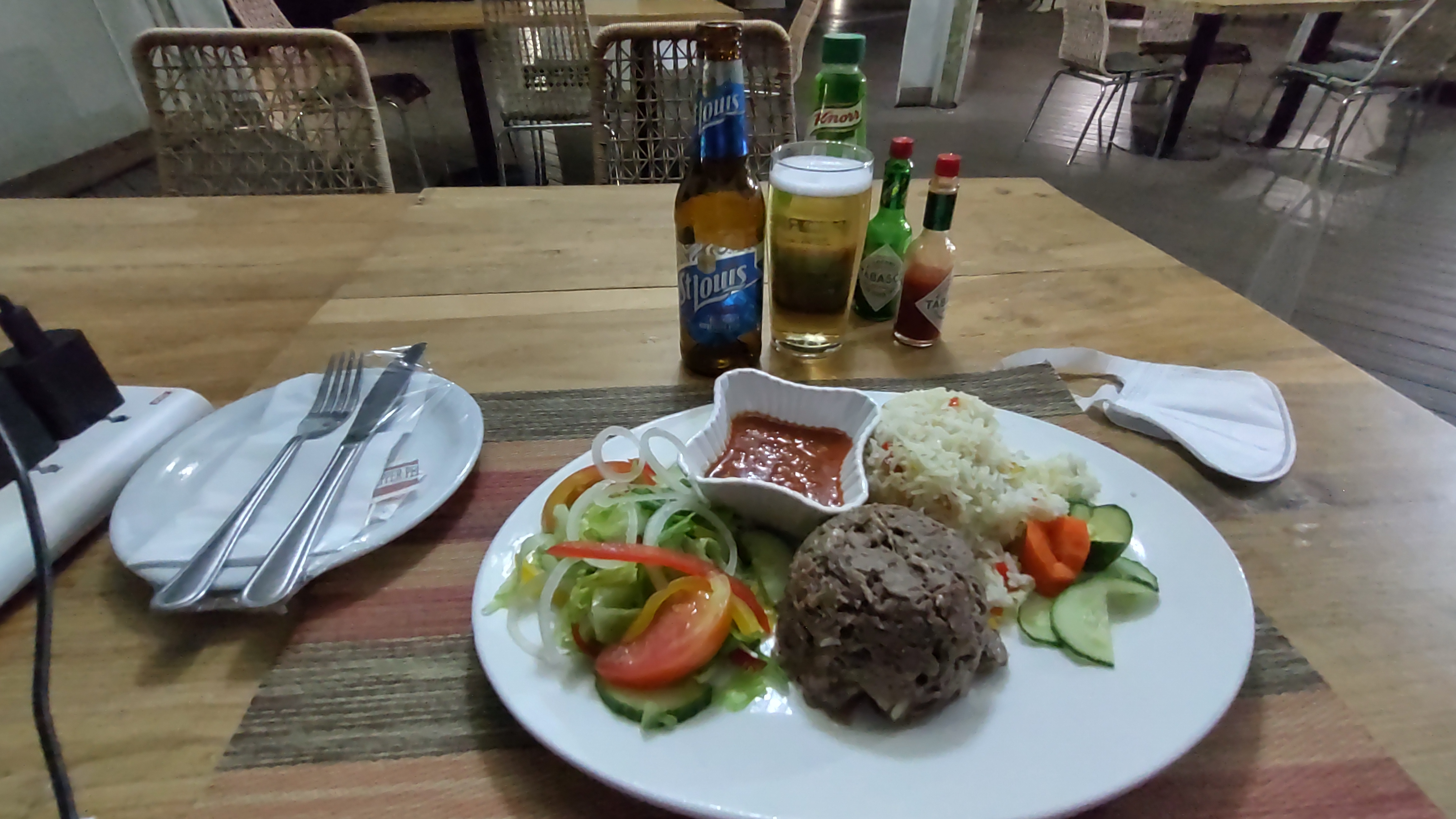
After a short nap I went to the restaurant for a night cap and dinner. The other reason was to charge all the devices and hook up on wifi. After consulting with Maya, my daughter, I ordered Seswaa with rice, tomato and onion sauce and veggies. Seswaa is boiled and pounded beef normally used at ceremonial gatherings. A couple of pints of St. Louis beer anticipated the dining experience. The restaurant overlooks the Gorge and is a very peaceful and serene setting to wind up the day. Three scoops of vanilla ice-cream in chocolate sauce rounded up the meal. I was charged and so were the devices. It was a lonely drive back to the tent in pitch darkness.

An African Safari - Day 1 – 10 March 2022 - Gaborone to Serowe - Khama Rhino Sanctuary - 402 km

Kiron drove me to the Sir Seretse Khama International Airport after dropping Eva at the Thornhill School and a short prayer at the grotto of the Cathedral. At the Hertz counter near the arrival lounge we spent a few anxious moments trying to get my Debit Card accepted. Finally when it was, the transaction was declined, for God knows what reason. Embarrassing to say the least, I had to rely on Kiron's Credit Card to make the 10025 BWP payment, which included a BWP 2500 refundable deposit.

Copies of my Passport and Indian Driving Licence supported the hire besides Kiron's residence address. Once the paperwork was done with, another person walked us over to the car, a relatively new VW Polo. The manual transmission vehicle had done just 7370 km and was registered in South Africa. I checked a few things with the Hertz employee who did the inspection paperwork for the formal handing over. A prominent chip on the windshield was its only apparent defect. He explained how the reverse gear worked, opening the gas tank, type of fuel it took in and parking gear. Took leave of Kiron after moving my luggage into what would be my companion for the next 11 days of the African Safari.

I took my time carefully positioning things in the car, the charger, mobile holder, sunglass, food, water, wet wipes, etc. They all had to be within easy reach while driving. The 15th edition of Record Drive started by 8.30 am. The day was bright and clear, in fact quite hot. It was a long time since I have been on manual transmission for a long drive. It is natural to forget using the clutch at times. Fortunately, I had some time within the Gaborone city limits to build a rapport and working relationship with the Polo companion. The A1 was initially four laned and grid separated. Evidence of agribusiness was prominent with warehouses and equipment garages. Vendors had started putting up their wayside kiosks to sell their daily stuff. The drive to Mahalapye was scenic and smooth. Most of the 200 km stretch was 120 kph, but permissible speed limits varied between 80 and 60 kph in villages and other busy places. The surprising fact is that the top speed of 120 kph is permitted on single lane highways.

Just short of Mahalapye I came across the location where the Tropic of Capricorn passes through in Botswana. Columnar joints have been installed here to mark the imaginary southernmost latitude Tropic. The 13 joints indicate the countries through which the Tropic of Capricorn passes around the world. Besides, the Tropic of Capricorn passes through three oceans, namely Indian, Atlantic and Pacific. The columnar joints were found near Francistown and is believed to belong to the Mesozoic era, more that 180 million years ago. Many have likened the columnar joints to Stonehenge in UK. The new landmark was unveiled in 2018 and the old one lies just a few feet away from the present one.

As I was driving through Mahalapye, which is at the edge of the Kalahari Desert, I was astonished to see the HQ of Botswana Railways to my right. I detoured and drive to the barrier controlled gate of the HQ. The lady security guard asked me to park and go to the reception for permission to take photographs. At the reception they took a nod from a senior person, to who I explained that I am a retired Indian Railways officer. I walked around a bit and took some photographs of the building before getting back on to the road. Botswana Railways was developed in the 1980-90s by RITES India. The 890 km network is now in decline with hardly any passenger trains operating on the metre gauge sections. It is understood that there are plans to revive its business through government investment. However, the condition of some of the rolling stock I saw in the Mahalapye yard tells me that it is going to be an uphill mission.

Past Palapye, on the A14 route to Serowe, is the Morupule Power Plant and collieries. A 600 MW thermal plant at the same location got into issues due to differences of opinion on pricing between Botswana and China. More than 50 percent of Botswana's power requirement is met through import from South Africa and Zambia.

Serowe is Botswana's largest village and is the birth place of two of Botswana's past presidents. The village became a prominent cattle post after the Bamangwato tribe migrated from South Africa sometime in early 19th century. The development of the village is the story of the House of Khama. A visit to the Khama III memorial museum in Serowe proved illuminating, in the company of Kabo, the guide. The museum is the former home of Khama III and his family, built in 1910, that was ceded to the State to be converted as a museum to enlighten visitors about the way of life that was and is in the village and the development of Botswanian politics and democracy.

The museum has an entrance charge of BWP 50 for non-residents, which includes superb historical commentary by Kabo. The tradition shaking decision of Seretse Khama to marry a white lady, attempts to get him to forsake her and become Chief and his ascendance as Prime Minister and first President of Botswana are stuff of legend. While walking around the premise Kabo showed me the Marula tree, the fruits of which are used to make the famed Amarula liqueur, jams, squashes and the like.

At the Museum, the friendly lady at the reception connected me to the Khama Rhino Sanctuary office in Serowe. I was told that I could reach the Sanctuary for a half past three game ride. The sanctuary is nearly 30 km away from Serowe on the A14 Orapa highway. I reached the sanctuary a bit before 3.30 pm and paid the entrance and game drive fee totalling BWP 937. The game drive fee of BWP 850 odd is for four persons. However, since I was the only one about I had to bear the charges in full. The reception area has a small store with some refreshments and memorabilia for purchase. I was assigned the young Duncan in a 9-seater Toyota Hilux to be my driver and guide.

The Khama Rhino Sanctuary was established in 1992 covering more than 8500 hectares of erstwhile settlements and is a community initiative to save the White Rhino population and the once pristine wilderness. More than 90 percent of the people who work at the sanctuary are from the community. Currently the sanctuary has 60 white and black rhinos, 30 giraffe, 500 zebras, impalas, springboks, red hat beasts, elands, warthogs, wildebeest, Oryx, leopards, hyenas, Kori bustard and the like.

The Kalahari Sandveld can be done in a 4x4 self-drive vehicle too. It was indeed fascinating to be so up close with the wildlife. Duncan explained the difference between the white and black rhinos. The former feeds on grass and hence, their necks point to the ground and their jaws are round to pound the grass they feed on. A full grown male weighs about 2.3 tins and the back of their feet are W shaped. The black rhino, on the other hand, are smaller at 1.2 tins and feed in leaves. Hence, they have a pointy jaw that is held parallel to the ground. The back of their feet are U shaped.

The lines on the zebra are unique like the human fingerprint; no two zebra hides have the same pattern. The animals in the sanctuary feed and drink what is available within its contours. The leopard and hyenas feed on Impalas and Springboks, which keep the population in check. There are no elephants, lions or buffaloes in the sanctuary. Just like the Big Five of elephant, lion, rhinoceros, buffalo and leopard are the ugly five, namely, warthog, vulture, hyena, Moravou stock and wildebeest. The two hour tour was educational and brought home the efficacy of such community initiatives.

On the way back to the pleasant Rest and Digest guesthouse I was staying in I stocked up on a few bottles of St. Louis beer, a loaf of bread and smoked ham. The friendly ladies at the guesthouse cooked me a dinner of beef roast, flavored rice and vegetable salad.


ATM Tour – Impressions – Day 10 – 20 January 2026

"The more you sweat in training the less you bleed in battle." - Navy Seals saying I completed the ATM Tour on 19 January 2026 and...